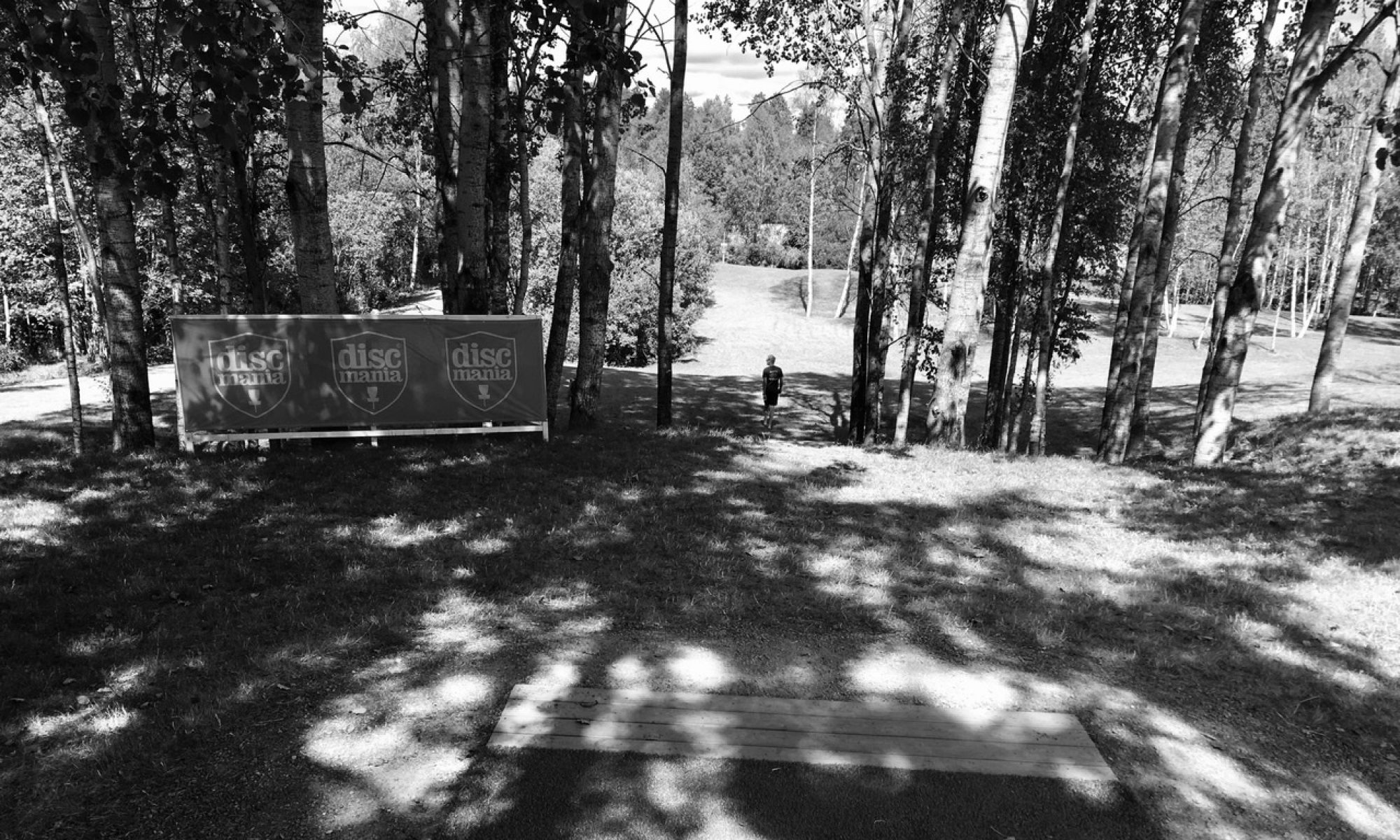

The SV Boostedt Disc Golf Center, which now features 22 holes, was voted one of the top 10 best disc golf courses in Germany by UDisc in 2026. It has been a long and exciting journey from the initial idea in 2017 to the current club activities of the disc golf division and the SV Boostedt Disc Golf Center course.
This spring, Mats Kipper interviewed Kai Christophersen to share Kai’s tips and experiences with other initiatives.

SV Boostedt hosts a national disc golf tournament twice a year—the SV Boostedt Spring Open and the SV Boostedt Winter Open—runs a quarterly league (handicap tournament series) every Saturday, and has developed a dynamic and fantastic disc golf community for Schleswig-Holstein in Boostedt since 2018.
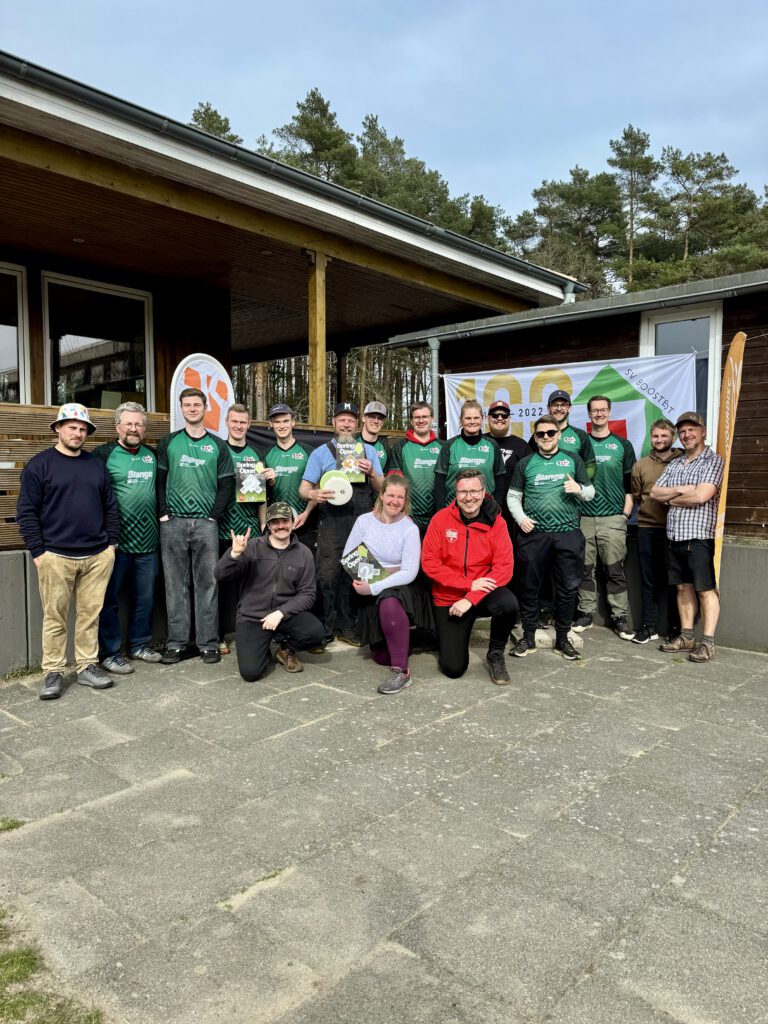
Kai is the founder and head of the disc golf division at SV Boostedt von 1922 e.V., a Discmania Ambassador Team member, and a disc golf coach (DOSB C license). He founded the disc golf community in Boostedt and the Boostedt Disc Golf Center course, and has guided it through all the ups and downs from day one.
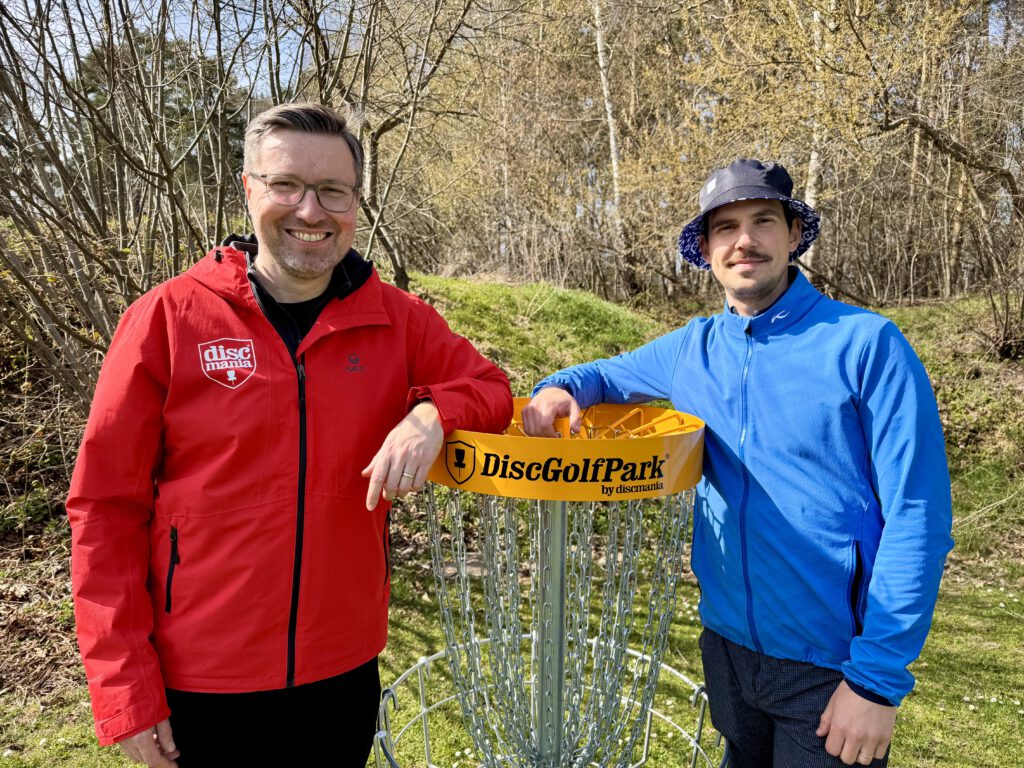
Kai Christophersen (left), Mats Kipper (right)
Maybe this interview will answer the question, “How to Boostedt Disc Golf Center?” Enjoy the read!
The Beginnings in Boostedt
Mats: How did the idea to establish a disc golf course in Boostedt originally come about?
Kai: “I’m often in Finland during the summer—I have Finnish roots, German and Finnish citizenship, and was born on the Arctic Circle. There, disc golf is truly part of everyday life: almost every town has a course, and in the supermarket, discs are practically right next to the diapers. That fascinated me. I gave it a try, was immediately hooked—and thought: This must be possible in Boostedt, too.
Disc golf is close to nature, appeals to all generations, and is incredibly accessible. You get a quick sense of achievement, you’re outdoors, you connect with others—it’s just fun. By the summer of 2017, it was clear to me: I wanted to build a course and a club structure for it in Boostedt. In 2018, I then made that a reality at SV Boostedt.”
Mats: Who made the initial contact with the sports club/community, and how did that contact come about?
Kai: “I made the first contact with SV Boostedt myself in 2018—and I wanted to do it professionally from the start. So I reached out to Discmania in Finland beforehand, presented my idea, and organized support—especially with good visual material and a clear overview of the sport. Through my German contact, Gregor Marter, I really got some momentum—and I’m still grateful for that today.
At the same time, I set up my blog (discgolfkueste.de) as a guide for anyone interested: What is disc golf, how does it work, what defines disc golf in recreational and competitive sports, and why does it make sense for a club? Then I scheduled a meeting with the board—and there I encountered a great deal of openness. The municipality wasn’t the primary point of contact at the beginning, because the initial focus was on a club program at the sports park. Fundamentally, however, the municipality and local politics are of great importance for the success of a disc golf program in a community.”
Mats: What role did the person at the sports club play whom you initially spoke with? Was that the actual decision-maker?
Kai: “Yes—the board was the central point of contact and also the decisive one. It came down to two things: a new division within the club and the use of the club’s own sports park. For that, you need clear approval and, above all, trust.”
Mats: How did you initially approach the sports club? Did you have a concept prepared, or was it more of an informal conversation?
Kai: “Both. We had a casual exchange—but at the board meeting, I had a structured presentation that covered all aspects: the sports concept, target groups, safety, maintenance, and costs.
It was important to me to take an evolutionary approach: not ‘we’ll build 18 holes course right away,’ but to start small and grow with membership development—in other words, to keep risks transparently low. We had already presented an idea for how we could start in the front forest with 6 baskets and 9 holes.
And I made it clear: I personally stand behind the new sports offering and am contributing a lot of personal commitment and my own effort. For a club, that’s crucial—no one wants to invest only to find that two years later, no one’s left. This has also proven true in practice: On Sports Day in 2018, I immediately offered an introductory event, still using baskets borrowed from Gregor Marter and with my first fellow enthusiast, Berko Guschall—and after that, for years, I was on the course every Saturday, rain or shine, often alone at first, later with an increasingly larger group, always actively involved in course maintenance, at village events, during school field trips, or even as an interview subject for the local press, to reliably promote the disc golf program and, in doing so, also demonstrate personal responsibility for it.”
Mats: What concerns or objections came up right at the beginning?
Kai: “The usual ones: land use, potential conflicts with existing sports, and the maintenance effort—especially in the forest. And one issue was extremely important to me personally: safety. Disc golf is fun, but flying discs can be dangerous if you plan it wrong.
That’s why I made sure from the very beginning that the course was designed so that no one would be endangered even without supervision—meaning throwing directions, natural fades, and distances. A single stupid accident can set a young sport back massively.
There were also discussions with disc golfers who wanted to grow as much as possible—but I was firm on this: safety and club harmony are more important than, say, ‘one more hole.’”
Mats: How long did it take from the first meeting to the approval of the first 9 holes?
Kai: “From the first contact in 2018 to the official founding in early 2019 and the construction of the first 9 holes in spring 2019—about a year.”
The first 9 holes—approval process
Mats: Who legally owns the property?
Kai: “The course is located in the SV Boostedt sports park—so it’s club property. The sports park is leased from the municipality free of charge—that’s a typical arrangement for many sports clubs.”
Mats: What formal approval steps were necessary?
Kai: “The approval of the club’s board was crucial. Because it’s club property, the process was handled internally—clear, straightforward, and transparent.”
Mats: Did other sports departments need to be involved?
Kai: “Yes—and that was a key factor in our success. Especially because of the proximity to the soccer fields. Close coordination within the club was part of the plan from the very beginning.”
Mats: Were there any requirements or conditions?
Kai: “A key point was forest maintenance. For the construction, we had to thoroughly clean up and maintain the wooded areas—at first often alone or in pairs, and then with many helping hands. That took a lot of time and passion.”
Mats: What insurance issues arose?
Kai: “Disc golf was integrated into the club’s structure as a division, so members are insured through the club. Otherwise, use of the course is at one’s own risk.”
Expansion & Development of the Course
Mats: When did the idea to expand further come up?
Kai: “Relatively quickly—because usage and interest have grown. But always in an evolutionary way. First, operate it stably; then professionalize it; then expand it. Ultimately, that also means more holes and more maintenance work, which must not overwhelm the existing members.”
Mats: What was particularly important to you during the expansion?
Kai: “Three things: visibility, professionalism, maintenance.
Visibility: A central, professional course map at the entrance and signs at the throwing areas—otherwise, prospective players often don’t even see the baskets. Signage draws attention; it acts like advertising banners and provides orientation.
Professional sports facility: Professional baskets, fixed tee areas (ideally artificial turf, or paved), clear wayfinding—only then will the sport be perceived and recognized as a ‘real sport.’
Ongoing grounds maintenance: A well-maintained course attracts people—an overgrown one deters them.
Important from my perspective: Soccer players don’t play on a bad field, and beach volleyball players don’t play over a rope. Disc golf must therefore set and meet the same standards to be taken seriously as a recreational and competitive sport.”
Mats: What had changed since the initial approval?
Kai: “We were established: regular training sessions, tournament experience through the SV Boostedt Spring and Winter Open (first held in 2019), a strong community. And above all: trust. The club realized that we think sustainably, don’t overuse the facilities, are considerate of other sports, and actively run our sports program. A club is a social structure—if you respect that, you can accomplish a great deal together.”
Mats: Did you have to obtain new approvals?
Kai: “Yes—every expansion was carefully coordinated with the board again.”
Mats: Tree and shrub maintenance: How did that go?
Kai: “Intensive maintenance, but nature-friendly and well-planned. We invested hundreds of volunteer hours and coordinated two regular landscaping dates per year.
Based on experience, we scheduled maintenance during periods of low vegetation growth—spring or early fall—because otherwise you end up with an enormous amount of biomass that needs to be disposed of. That’s also why we deliberately schedule our tournaments during these low-vegetation phases.”
Mats: Were there any conflicts with other sports?
Kai: “No major ones—because we communicated clearly and had clear rules. The key is: take others’ interests seriously, be transparent, and act consistently. Communication really is the be-all and end-all here.”
Mats: What was the biggest obstacle?
Kai: “The time and effort involved—which was entirely covered by volunteers.”
Using soccer fields for tournaments
Mats: How did you get permission to use soccer fields for tournaments?
Kai: “Through close coordination and because we handle it very responsibly. A day of disc golf tournaments puts less strain on the grass than a soccer game or practice with cleats—but we still protect the tee-off areas on the grass with artificial turf mats to avoid localized wear and tear.
And very important: take everything down and clean up completely in the evening. Nothing is allowed to be left on a soccer field—no hooks, no markings. If a soccer player gets injured because of a forgotten hook, that’s understandably a no-go.”
Mats: Were there any concerns from the soccer department?
Kai: “Of course, there are critical situations in individual cases—on both sides. The key is to react quickly, explain things clearly, and make it obvious: We take this seriously. That keeps our relationship stable.”
Relationship with the Sports Club & Funding
Mats: How has the relationship with the club developed?
Kai: “It was very close from the start and has become even closer. Disc golf is now an integral part of club life—with a great deal of mutual trust.”
Mats: What are the benefits for the sports club?
Kai: “I see the following benefits, among others:
Recruiting members across all age groups and fitness levels
A modern, attractive sports offering in a trending sport
Positive public image / media coverage, as schools and youth centers also use the facility
Revitalization of the sports park
Increased foot traffic even during non-training hours (positive side effect: less vandalism)
Strengthening ties with the community and the local economy (retail, restaurants, and gas stations), as travelers passing through and tourists take advantage of the disc golf facilities and stop in Boostedt, which actually has a significant positive impact on Boostedt
Mats: Are there any lease or usage fees?
Kai: “No. Disc golf is a club division and uses the grounds as part of the club’s structure. For regular disc golfers in Boostedt, club membership is mandatory so that we can maintain and further develop our offerings.”
Mats: How was the course financed?
Kai: “Through a combination of club support (primarily membership dues), the division’s own funds, grants (from the municipality and sports association)—and a great deal of volunteer work.”
Mats: Were there any public grants?
Kai: “Yes—through the club, we applied for and received grants from the municipality and sports association. However, the largest share comes from club support and our own funds. The advantage of a large club: If an application is clear and reasonable, the club can organize funding in a structured way. In my view, it’s important not to become too dependent on grant approvals; if necessary, start with small steps and grow gradually.”
Risks, Problems & Lessons Learned
Mats: What was more difficult than expected?
Kai: “The ongoing maintenance and labor required, especially in the forest.”
Mats: Were there any critical incidents?
Kai: “No—the respectful cooperation at the sports park has proven its worth, and we’ve been able to react quickly when things don’t go quite as planned.”
Mats: What would you do differently today?
Kai: “Looking back, not much—the most important lesson is: Volunteering isn’t just about your own division, but about the entire club. Solidarity and gratitude are key if you want to establish yourself in the long term.”
Mats: Biggest miscalculation?
Kai: “We underestimated how rapidly disc golf is growing—and how much enthusiasm it generates. That’s wonderful, but sometimes you have to rein in good ideas to maintain focus. Volunteer capacity is a limited resource—so you have to make decisions like a ‘volunteer business manager’: Where do we invest our energy—and where not. That’s why I’d like to once again express my immense gratitude to the disc golf community in Boostedt. Without everyone’s active commitment, we wouldn’t have developed so well. I’d also like to thank Discmania Discs for their years of support; they welcomed me early on as an ambassador to Team Discmania and have stood by me throughout. Thank you very much.”
Mats: Any advice for other initiatives?
Kai: “
Involve the club early on; utilize the club’s existing structures (membership management, contacts with the municipality and associations, club grounds, financing, etc.), so you can focus on the sport and public relations
Plan your own contributions realistically and be grateful: It’s all volunteer work.
Maintain regular and transparent communication with all stakeholders and those involved
Promote disc golf as a community, family, and recreational sport; always make getting started as easy as possible
Thank you very much for suggesting this interview and for our conversation today. I really enjoyed it. Your questions touched on exciting aspects of setting up a disc golf course within a club.
I hope I was able to provide some inspiration and initial tips for disc golfers who are currently facing a similar challenge. Of course, I’m also happy to be available afterward for questions and tips.
Disc golfers currently facing similar challenges are welcome to reach out to me via my Instagram profile @discgolfkueste, my website of the same name, or my email kch@discgolfkueste.de. I’m happy to support #growthesport! Thank you very much.”